


Do you want to contribute by writing guest posts on this blog?
Please contact us and send us a resume of previous articles that you have written.
Mammoth Anna Kemp: Unraveling the Astonishing Life of a Prehistoric Giant

Have you ever wondered what life was like for our prehistoric ancestors roaming the vast landscapes of the Ice Age? One of the most fascinating creatures from that time is Mammoth Anna Kemp, a giant of an animal that captivates the imaginations of scientists and enthusiasts alike. In this article, we will delve into the incredible world of Mammoth Anna Kemp, exploring its characteristics, habitats, behaviours, and the extraordinary legacy it left behind.
The Rise of Mammoth Anna Kemp in the Ice Age
During the Pleistocene epoch, approximately 2.6 million to 11,700 years ago, the world looked very different. Massive ice sheets covered vast areas of land, and the Earth was experiencing a cold climate. It was in this frigid environment that the magnificent Mammoth Anna Kemp evolved.
Mammoth Anna Kemp, scientifically known as Mammuthus Anna Kempensis, belonged to the elephant family. However, it stood out as a distinct species, adapted to thrive in the harsh conditions of the Ice Age. A fully grown Anna Kemp could reach heights of up to 14 feet and weigh an astounding 10 tons, making it one of the largest land mammals to have ever existed.
4.5 out of 5
| Language | : | English |
| File size | : | 28623 KB |
| Print length | : | 18 pages |
| Screen Reader | : | Supported |
The Physical Characteristics of Mammoth Anna Kemp
Mammoth Anna Kemp possessed an array of remarkable physical attributes that allowed it to adapt and survive in the icy landscapes it called home.
Its most striking feature was its immense size. Anna Kemp had long, curving tusks that extended up to 15 feet, which it used for various purposes, including digging for food and defense against predators. These magnificent tusks were a defining characteristic that set it apart from modern-day elephants.
The coat of Mammoth Anna Kemp was another distinguishing trait. Covered in long, shaggy hair that protected it from the bitter cold, this dense fur was a vital adaptation that enabled the species to withstand the freezing temperatures of the Ice Age.
Habitat and Diet
Mammoth Anna Kemp was highly adaptable and inhabited a wide range of environments, including grasslands, forests, tundras, and even subalpine regions. Its incredible adaptability was a crucial factor in its successful survival throughout the Ice Age.
As herbivores, Anna Kemp primarily grazed on grasses, sedges, and other low-lying vegetation. Its long, muscular trunk aided in plucking vegetation and conveying it to its mouth. The species' large size and high food requirements meant that they needed to roam vast areas in search of sustenance.
Social Structure and Behaviors
Mammoth Anna Kemp exhibited a complex social structure similar to that of modern elephants. They lived in matriarchal family groups led by a dominant female known as the matriarch. These groups often consisted of multiple generations, with younger females helping to care for the offspring.
Communication played a crucial role in the social interactions of Mammoth Anna Kemp. They vocalized through deep rumbling calls, while also utilizing body language, such as their iconic displays of charging or raising their tusks, to convey dominance or intimidate potential threats.
Extinction and Legacy
Unfortunately, Mammoth Anna Kemp, along with many other prehistoric species, faced eventual extinction towards the end of the Ice Age. Climate change, hunting pressures, and habitat loss are believed to be the primary factors contributing to their demise. The last known populations of Mammoth Anna Kemp survived on isolated islands, where they managed to persist until approximately 4,000 years ago.
While the species may no longer roam the Earth, their legacy lives on. Mammoth Anna Kemp left a treasure trove of fossils that continue to provide invaluable insights into the Earth's prehistoric past. Scientists have been able to reconstruct the lives of these magnificent creatures, unveiling their behaviors, physical characteristics, and even their genetic makeup through the analysis of preserved DNA.
Furthermore, efforts are underway to bring the species back to life through genetic engineering. Though still in the experimental stages, the possibility of seeing Mammoth Anna Kemp once again roam on Earth sparkles with both excitement and ethical considerations.
Mammoth Anna Kemp is undoubtedly one of the most remarkable species to have ever roamed the Earth. Its colossal size, unique adaptations, and social structures continue to captivate our interest and drive scientific exploration. As we uncover more about this prehistoric giant, the legacy of Mammoth Anna Kemp serves as a powerful reminder of the great diversity and richness of life that existed during the Ice Age. Who knows what further secrets are waiting to be unearthed from the icy depths of our planet's past?
4.5 out of 5
| Language | : | English |
| File size | : | 28623 KB |
| Print length | : | 18 pages |
| Screen Reader | : | Supported |
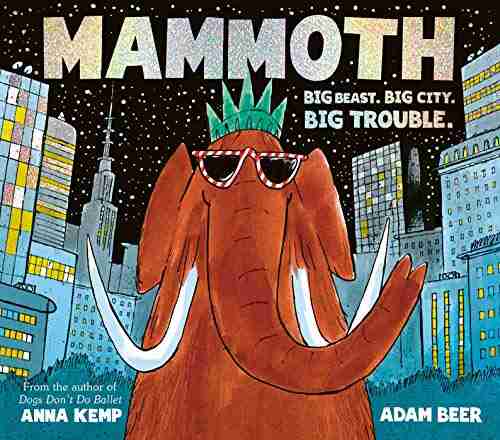
The funny, touching story of an Ice Age mammoth who finds himself in a modern day city from the bestselling author of Dogs Don't Do Ballet.
Big beast. Big city. BIG TROUBLE.
When an Ice Age mammoth finds himself in a modern day city, he's not at all sure what to make of this huge, gleaming forest. Strange birds in the sky, strange beetles on the ground and strange, shouty cavemen.
Is he the only mammoth in the WORLD?
A warm and and endearing story about finding your herd and a place to trumpet wildly from much-loved author Anna Kemp and exciting new illustrator, Adam Beer.
Other books by Anna Kemp:Dogs Don't Do Ballet
Rhinos Don't Eat Pancakes
The Worst Princess
Sir Lilypad
Dave the Lonely Monster

 Anthony Burgess
Everything You Need To Know About Building Referral...
Are you looking for ways to boost revenue...

 Glen Powell
 Aleksandr Pushkin
The Fascinating History of Afro Uruguay - Unveiling the...
Afro Uruguay refers to the rich and diverse...

 Anton Foster
Reflections From Stubborn Son: A Journey of...
Have you ever encountered a stubborn...

 Brennan Blair
Discover the Revolutionary World of Protein Modelling:...
Protein modelling is an essential...

 Ricky Bell
The Best Old Fashioned Advice: Timeless Wisdom Passed...
Have you ever turned to your grandparents,...

 Isaiah Price
Embark on an Unforgettable Journey: The Sword and Sorcery...
Are you ready to be...

 Hassan Cox
The Enchanting World of Wendy Darling Comes Alive in...
Step into the magical world of Neverland...

 Ivan Turner
Adsorption Calculations And Modelling Chi Tien: Unlocking...
In the field of chemistry, adsorption is a...

 Harvey Hughes
Unleashing the Full Potential of a Team: How To Organize...
"Genius is 1% inspiration and 99%...
 Desmond Foster
The Fascinating Journey of George Romanes: From...
George John Romanes, born on May 20, 1848,...

 Adrien Blair
The Untold Truth: The Bible In The Early Church - A...
Lorem ipsum dolor sit amet, consectetur...
Light bulbAdvertise smarter! Our strategic ad space ensures maximum exposure. Reserve your spot today!

 Luke BlairUnleash Your Imagination with "She Professed Herself Pupil Of The Wise Man" -...
 John GreenUnveiling Intellectual Brilliance: A Compilation of Thought-Provoking Essays...














 Jordan BlairFollow ·18.2k
 Andy HayesFollow ·7.5k
 Langston HughesFollow ·2.1k
 Cormac McCarthyFollow ·16.6k
 Corey HayesFollow ·13.8k
 Seth HayesFollow ·5.2k
 Gustavo CoxFollow ·3.8k
 Casey BellFollow ·19.9k
