


Do you want to contribute by writing guest posts on this blog?
Please contact us and send us a resume of previous articles that you have written.
Unveiling the Wonders of Genetically Modified Organisms: Transgenesis in Plants

The Revolution of Genetic Engineering in Agriculture
Genetically Modified Organisms (GMOs) have been a topic of intense debate within the scientific community and society at large. While some view it as a groundbreaking solution to our global agricultural challenges, others express concerns about potential risks and long-term impacts. Today, we delve into the realm of transgenesis in plants, shedding light on the intricate world of genetic engineering and its potential implications.
Understanding Transgenesis
Transgenesis, a method used in genetic engineering, involves introducing genetic material from one organism into another to confer new traits or characteristics. In the context of plants, transgenesis allows scientists to modify their genetic makeup to improve their growth, yield, resistance to pests and diseases, and even enhance their nutritional value.
Traditionally, farmers and scientists have relied on selective breeding to enhance desirable traits in crops. This method, though effective to some extent, is time-consuming and often limited by the existing genetic diversity within species. Transgenesis, on the other hand, offers a precise and efficient way of introducing specific traits into crops, paving the way for new possibilities in agricultural practices.
5 out of 5
| Language | : | English |
| File size | : | 65978 KB |
| Print length | : | 124 pages |
| Screen Reader | : | Supported |
| X-Ray for textbooks | : | Enabled |
The Benefits of Genetically Modified Plants
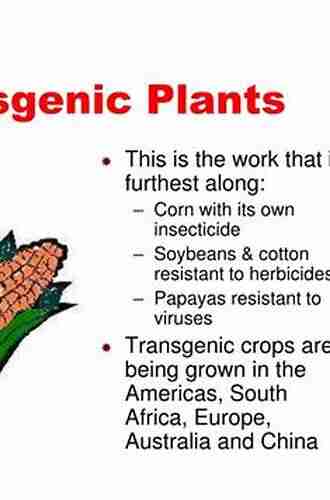
One of the key advantages of genetically modified plants is their increased resistance to pests and diseases. By introducing genes responsible for producing specific proteins or toxins that are harmful to pests, scientists are able to create crops that can defend themselves against common threats. This reduces the need for chemical pesticides, leading to lower environmental impact and improved crop yield.
Furthermore, genetically modified plants can be engineered to withstand harsh environmental conditions, including drought, extreme temperatures, and soil salinity. As climate change continues to disrupt traditional farming patterns, these modified crops offer a glimmer of hope for ensuring food security in the face of unpredictable weather patterns.
The nutritional quality of crops can also be enhanced through genetic modification. Scientists are able to introduce genes that increase the production of essential vitamins and minerals, addressing micronutrient deficiencies prevalent in certain regions of the world. This can have a significant impact on improving public health, particularly in developing countries where access to nutrient-rich foods is limited.
Ethical Considerations and Safety Concerns
While the potential benefits of genetically modified plants are undeniable, it is crucial to address the ethical considerations and safety concerns associated with their usage. Critics argue that GMOs could disrupt natural ecosystems and harm biodiversity. Cross-pollination between genetically modified and wild plants could lead to the spread of modified traits into the wild, potentially altering the balance of ecosystems and threatening native species.
Furthermore, there are concerns about the long-term effects of consuming genetically modified plants. Some worry about the potential allergenicity or toxicity of certain modified crops, as altering their genetic makeup could introduce unknown proteins or compounds. Rigorous testing and regulation are necessary to ensure the safety of GMOs before they enter the market.
Future Implications and
The field of genetic engineering and transgenesis in plants holds immense potential for transforming agriculture and addressing the challenges we face in feeding a growing global population. However, a balanced approach is crucial to ensure both innovation and safety. Scientific advancements should be coupled with rigorous safety assessments, transparent communication, and ethical considerations.
As we continue to uncover the mysteries within the realm of genetic engineering, it is essential that we join the ongoing discussion surrounding GMOs and their implications. The future lies in our ability to harness the power of science while safeguarding the environment and our health. Only then can we fully embrace the wonders of genetically modified organisms and their potential to shape our world.
5 out of 5
| Language | : | English |
| File size | : | 65978 KB |
| Print length | : | 124 pages |
| Screen Reader | : | Supported |
| X-Ray for textbooks | : | Enabled |
This work reviews the theoretical and historical basis of genetic engineering, particularly in regard to genetically modified plants, and details techniques of creating genetically modified organisms. It describes research programs and results in areas such as agro-food, health, and the environment, and examines practical, legal, and ethical questions posed by society and the responses of scientists, legislators, and industry. B&W photographs of equipments are given.

 Anthony Burgess
Everything You Need To Know About Building Referral...
Are you looking for ways to boost revenue...

 Glen Powell
 Aleksandr Pushkin
The Fascinating History of Afro Uruguay - Unveiling the...
Afro Uruguay refers to the rich and diverse...

 Anton Foster
Reflections From Stubborn Son: A Journey of...
Have you ever encountered a stubborn...

 Brennan Blair
Discover the Revolutionary World of Protein Modelling:...
Protein modelling is an essential...

 Ricky Bell
The Best Old Fashioned Advice: Timeless Wisdom Passed...
Have you ever turned to your grandparents,...

 Isaiah Price
Embark on an Unforgettable Journey: The Sword and Sorcery...
Are you ready to be...

 Hassan Cox
The Enchanting World of Wendy Darling Comes Alive in...
Step into the magical world of Neverland...

 Ivan Turner
Adsorption Calculations And Modelling Chi Tien: Unlocking...
In the field of chemistry, adsorption is a...

 Harvey Hughes
Unleashing the Full Potential of a Team: How To Organize...
"Genius is 1% inspiration and 99%...

 Desmond Foster
The Fascinating Journey of George Romanes: From...
George John Romanes, born on May 20, 1848,...

 Adrien Blair
The Untold Truth: The Bible In The Early Church - A...
Lorem ipsum dolor sit amet, consectetur...
Light bulbAdvertise smarter! Our strategic ad space ensures maximum exposure. Reserve your spot today!











 Clarence MitchellUncovering the Untold Stories: The Legendary Tales of Grimsby Streets and...




 Braeden HayesThe Expulsion Of The Germans After The Second World War: A Forgotten Tragedy

 Jules VerneFollow ·9.6k
 Francis TurnerFollow ·10.5k
 Donald WardFollow ·17.5k
 Neil ParkerFollow ·2.1k
 Alec HayesFollow ·12.7k
 Oliver FosterFollow ·3.2k
 Devin CoxFollow ·13.1k
 Philip BellFollow ·15.1k
